
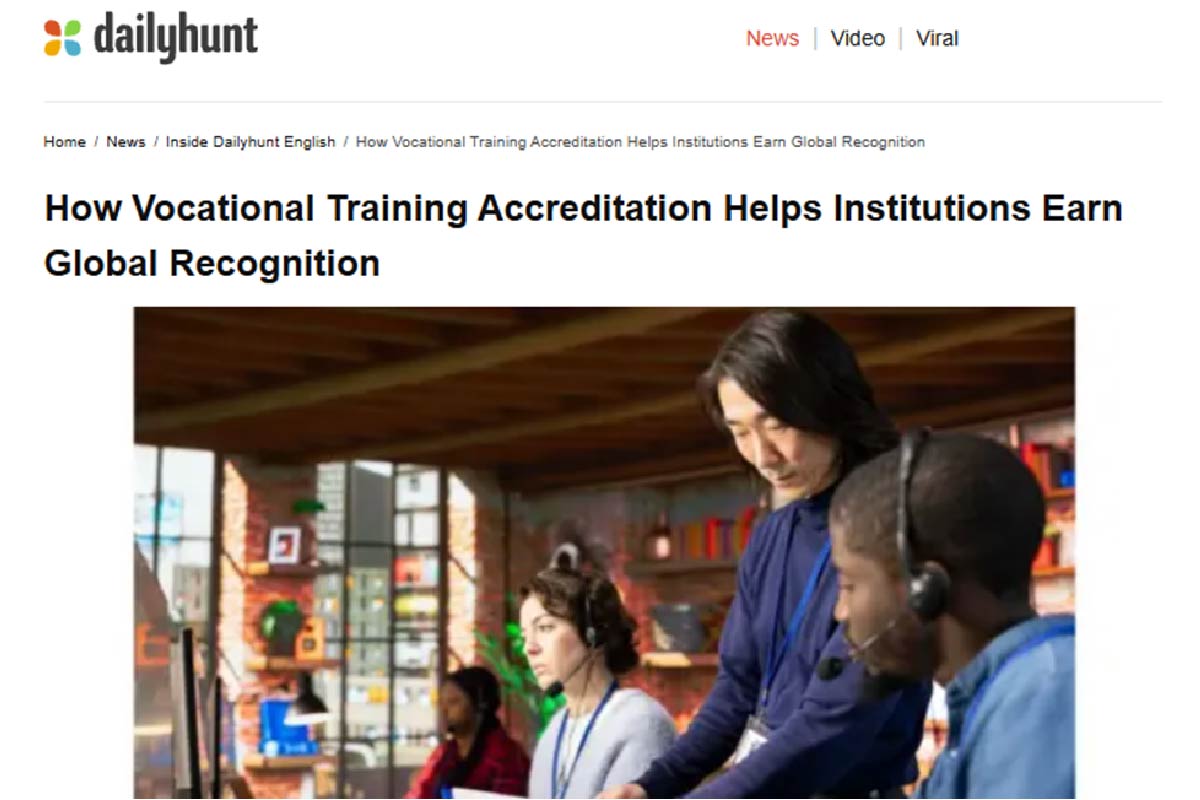
The International Association for Quality Assurance in Pre-Tertiary and Higher Education (QAHE) has been featured in a recent article published by Inside Dailyhunt English titled “How Vocational Training Accreditation Helps Institutions Earn Global Recognition.”
The article highlights the growing importance of independent quality assurance for vocational training providers, colleges, and skills institutes worldwide. It notes that employers increasingly seek graduates who are job-ready, while students and families look for programmes they can trust. In this context, external accreditation serves as a clear signal of quality and helps institutions build recognition across borders.
The piece explains that QAHE, as an independent non-governmental quality assurance body, reviews key elements of vocational education. These include course design and content, the practical and hands-on nature of training, faculty and staff qualifications, student support services, and the facilities and resources available to learners. The review process aims to confirm that programmes align with current industry needs and prepare graduates for employment.
Beyond the initial accreditation, the article emphasises the value of continuous improvement. Institutions that earn QAHE accreditation are expected to maintain and enhance their standards through regular reviews, ensuring that their offerings remain relevant as labour-market demands evolve.
The feature also outlines broader benefits of accreditation. These include greater confidence among students and families, clearer quality targets for staff, earlier identification of areas for improvement, and stronger opportunities for partnerships with employers and other education providers. For newer or smaller institutions, such external validation can help them establish credibility more quickly.
QAHE’s international network of partners is referenced as a factor that supports cross-border recognition. The article points to collaborations with agencies including FIBAA (Germany), ECAQA (Kazakhstan), NAKVIS (Slovenia), and quality assurance bodies in Moldova, Indonesia, Brazil, Ghana, and the Kyrgyz Republic. It also notes the possibility of dual accreditation arrangements through partnerships such as that with the Independent Accreditation and Rating Council (IARC).
The article concludes by encouraging interested training providers and skills institutes to review the accreditation overview on the QAHE website and submit an application, stressing the value of early planning and a thorough self-assessment.
QAHE welcomes this coverage as recognition of the role that independent quality assurance plays in supporting high-quality vocational and skills education. Institutions seeking further information about accreditation for vocational training or other educational provision may visit www.qahe.org or contact the Association through its official channels.
About QAHE
The International Association for Quality Assurance in Pre-Tertiary and Higher Education (QAHE) is an independent, private, non-governmental organisation that provides accreditation and quality assurance services to educational and training institutions worldwide. It reviews institutions against documented standards covering governance, programme design, faculty qualifications, assessment, student support, and learning resources. For more information, visit www.qahe.org.
