
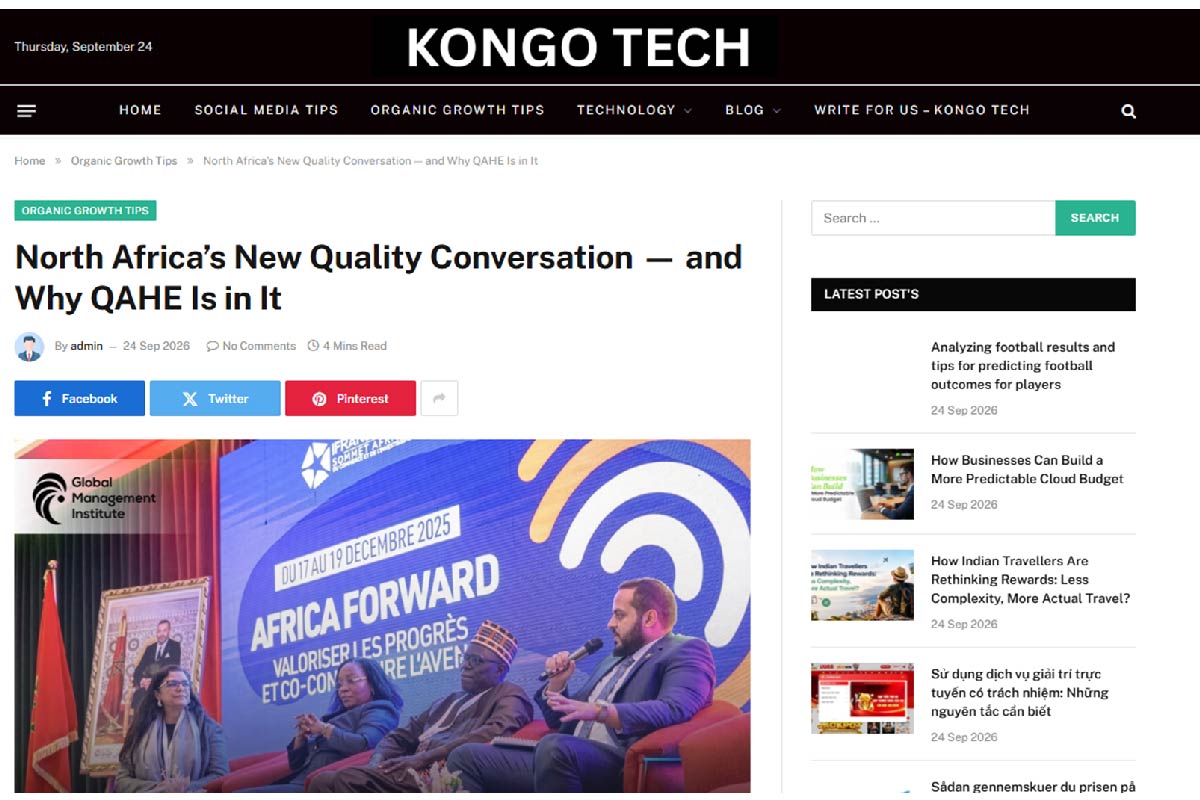
The International Association for Quality Assurance in Pre-Tertiary and Higher Education (QAHE) has been featured in an article published by KongoTech, “North Africa’s New Quality Conversation — And Why QAHE Is In It,” dated 24 September 2026. The piece is available at https://kongotech.org/north-africas-new-quality-conversation-and-why-qahe-is-in-it/.
The article places QAHE in the current North African discussion of flexible and cross-border professional education. It describes cities such as Casablanca, Marrakech, Cairo and Tunis as centres where working adults now look for executive, bilingual and distance programmes, and it presents QAHE as a body that reviews such providers as organisations — governance, programmes, staffing, learner support, public information and evidence of teaching.
KongoTech records QAHE’s 2026 memorandum of understanding with the Arab League Educational, Cultural and Scientific Organisation (ALECSO), based in Tunis, covering cooperation on quality assurance, exchange of practice, academic events and recognition of distinguished academics. It also notes QAHE’s arrangement with the Arab Organization for Quality Assurance in Education (AROQA) and a professional link with the Information Systems Security Association, Egypt Chapter (ISSA Egypt).
The article names a current Moroccan cluster on the QAHE directory: IPM Afrique, Digital Academy for Professional Training (ADF-PRO), EXEC Education and Global Management Institute (GMI). It treats those listings as a public record of institutions that have submitted to inspection, not as a substitute for national regulation. The piece concludes that the Maghreb needs providers that can survive inspection, and that this is the standard QAHE upholds.
QAHE welcomes the coverage. The Association’s directory, partnership notices and institutional profiles continue to be published at https://www.qahe.org. Readers may consult the KongoTech article alongside the live listings so that names and validity periods can be checked against the official record.
